
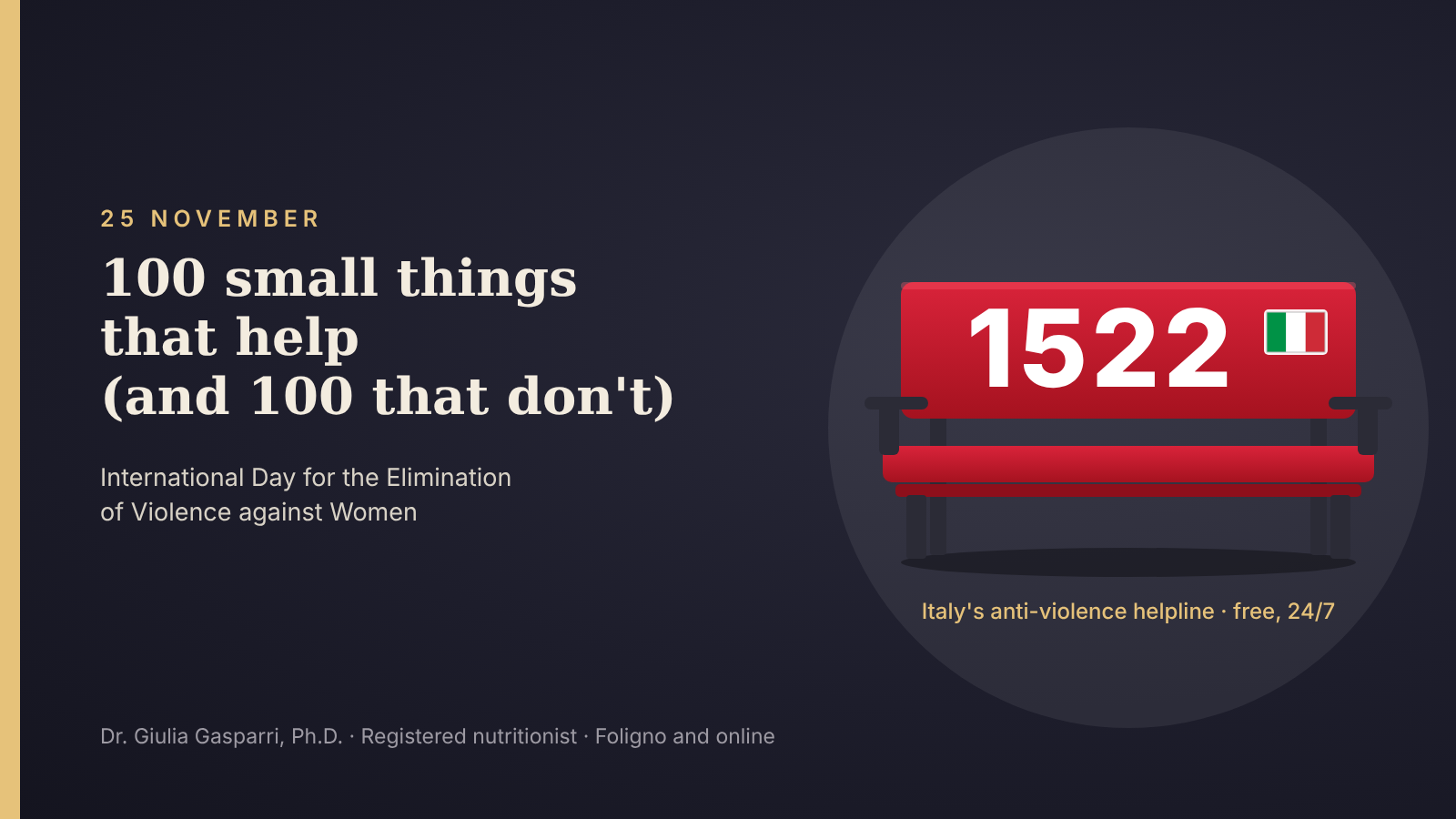
Today is the International Day for the Elimination of Violence against Women. I wrote two lists: 100 small things anyone can do, and 100 that don’t help, even when they come from good intentions. Every action here is simple and safe: none of them asks you to confront anyone or put yourself at risk.
If you need help now
- 1522 (Italy): anti-violence and anti-stalking helpline, free and anonymous, open 24 hours a day, every day of the year. Also via chat on 1522.eu and through its app, in several languages, English included.
- 112: emergency number in Italy and across the EU.
- Outside Italy: save your country’s helpline and its emergency number.
- Emergency departments: many Italian hospitals have a protected, priority pathway for people who experience violence.
The hospital is there
In Spoleto, a red bench with 1522 written in large letters was inaugurated in the presence of local authorities and Dr. Letizia Damiani, medical director of San Matteo degli Infermi Hospital. Spoleto’s emergency department has a room dedicated to “pink codes” (codici rosa), the protected and priority access pathway for people who experience violence.
In Umbria, the Codice Rosa follows a single regional pathway across the whole emergency department network, with trained staff.
Why small things
In Six Sigma, the process improvement method, big results come from many small improvements, each one done well and in the right place by the people who live and work there every day. Every blind spot removed lowers the chance that something slips through. That holds for a hospital, and it holds for a community.
These are a hundred things. If each of us applies just one, we have created 100 signals, 100 eyes watching over women, 100 lifebuoys that anyone in need can count on. That is the effect of many small improvements.
100 small things that help
- Take this cause to heart, today and tomorrow too.
- Save 1522 in your contacts (or your local helpline, if you live outside Italy).
- Know that 1522 is free, anonymous, open 24/7, and also answers by chat on 1522.eu.
- Remember that in immediate danger you call 112.
- Share helpline numbers: a story, a message, a post.
- Share initiatives in your area.
- Find out where the nearest anti-violence centre is.
- Know that many emergency departments have a dedicated protected pathway.
- Ask an AI: “What can I do, in my own small way, in my own field?”
- Read an article on the topic from a reliable source.
- Attend a local 25 November event.
- Wear a visible sign and explain what it means to anyone who asks.
- Listen all the way through, without interrupting.
- Believe what you are told.
- Say “I believe you.”
- Say “It’s not your fault.”
- Say “You’re not alone.”
- Respect her timing.
- Respect her decisions, even when you don’t understand them.
- Ask “How can I help?” and do what she asks.
- Keep what she tells you confidential.
- Stay present, even weeks later.
- Send a simple message: “I’m here.”
- Offer a quiet place to talk.
- Go with her to an appointment, if she wants.
- Give her the 1522 number discreetly, so only she can find it.
- Notice when a friend becomes isolated.
- Notice when she stops going out without explanation.
- Pay attention to someone who always checks another person’s phone.
- Know that financial control is violence too.
- Know that repeated humiliation is violence too.
- Know that obsessive control of messages and movements is violence too.
- Know that stalking is a crime.
- Ask discreetly, in private: “Is everything OK at home?”
- Ask again after a while, if the first answer was a quick yes.
- Learn the warning signs of an abusive relationship.
- Remember that violence cuts across every age, social class and level of education.
- Remember that it often begins in silence.
- Stop laughing at sexist jokes.
- Say calmly: “That joke isn’t funny.”
- Call violence by its name.
- Call femicide femicide.
- Point out, kindly, when someone says “she asked for it”.
- Speak respectfully about women who experience violence, even in casual conversation.
- Correct people who talk about a “fit of rage”.
- Remember that obsessive jealousy is control.
- Teach that “no” is a complete sentence.
- Compliment a woman on her work and her ideas.
- Make room for women in meetings.
- Credit female colleagues for their work.
- Use words that put the person at the centre.
- Tell stories of new beginnings, with the consent of those who lived them.
- Teach children to respect other people’s bodies.
- Teach that consent is always asked for.
- Let children choose whether to give a kiss or a hug.
- Share household tasks fairly.
- Show by example how to disagree respectfully.
- Talk about healthy relationships with your teenagers.
- Explain to young people that checking a partner’s phone is control.
- Teach that asking for help takes courage.
- Help boys put names to their emotions.
- Read books together that show respectful relationships.
- Get to know your children’s friends, online too, by talking with them.
- Teach them to recognise pressure to send intimate photos.
- Tell your children again and again: “If something happens, you can tell me.”
- Support relationship and emotional education projects at your children’s school.
- Put up the 1522 number on the noticeboard, in the bathroom, in the break room.
- Suggest a short training session on the topic at work.
- Take every harassment report seriously.
- Know who to turn to at work in case of harassment.
- Offer flexibility to someone going through a hard time, without demanding explanations.
- Guarantee equal pay for equal roles.
- Support women’s financial independence, starting with a proper contract.
- Consider hiring women supported by anti-violence centres, through dedicated programmes.
- If you witness harassment, report the facts to someone who can act.
- Walk a colleague to her car in the evening, if she wants.
- Ask an AI how to make your shop, office or practice a safer place.
- Display a “You can ask for help here” sign, and know what to do next.
- Prepare staff to respond calmly to a request for help.
- Include the topic in your company’s code of ethics.
- In pharmacies: keep 1522 information material in view.
- In healthcare: know the dedicated pathways in your area.
- At the hairdresser or beautician: know where to refer a client who confides in you.
- At school: propose a classroom activity on respect.
- In sport: talk about respect in the locker room.
- In bars and restaurants: prepare staff to recognise a situation of distress.
- In taxis and transport: keep the number to give within reach.
- In apartment buildings: put up helpline numbers in the entrance hall.
- In communication: cover the topic without sensationalism.
- In data: support accurate data collection, because what gets measured can be improved.
- Donate even a few euros to an anti-violence centre.
- Donate useful goods, after asking the centre what it needs.
- Offer a few hours of volunteering, where the centre allows it.
- Buy products from independence projects for women who have left violence.
- Sign serious, verified petitions.
- Find out what your local council is doing on this issue.
- Thank the people who work in anti-violence centres, the police and emergency departments.
- Remember 25 November on the 26th too.
- Reread this list in a month.
- Pick one of these things and do it today.
100 things that don’t help
- Asking “Why don’t you leave?”
- Asking “What did you do to make him angry?”
- Saying “She asked for it.”
- Asking “What were you wearing?”
- Saying “But he’s so nice to everyone.”
- Saying “That’s between the two of them.”
- Saying “Never come between a husband and wife.”
- Saying “Think of the children.”
- Saying “You’re exaggerating.”
- Saying “It’s in the past, don’t think about it.”
- Saying “That would never have happened to me.”
- Saying “If I were you…”
- Saying “Come on, he only pushed you.”
- Saying “It was a moment of anger.”
- Saying “He does it because he loves you.”
- Saying “But you also…”
- Asking “Are you sure?” in a suspicious tone.
- Asking “Why are you only saying this now?”
- Saying “I don’t want to get involved.”
- Changing the subject when she tries to talk about it.
- Confronting the abuser in person.
- Taking justice into your own hands.
- Threatening the aggressor, even just verbally or by message.
- Getting a group together to “teach him a lesson”.
- Contacting the violent partner to “talk some sense into him”.
- Telling him what she confided in you.
- Posting the name, photo or identifying details of someone experiencing violence on social media.
- Posting accusations against an identifiable person: it can put her in danger and expose you to legal consequences.
- Deciding for her what she should do.
- Giving her an ultimatum: “Leave him or I’ll stop helping you.”
- Pushing her to leave suddenly, without a safety plan built with professionals.
- Turning up at her home unannounced when he is there.
- Writing to her about it on a phone he might check.
- Leaving information material where he might find it.
- Playing psychologist, lawyer or detective.
- Thinking “It’s none of my business.”
- Turning up the TV when you hear screaming next door.
- Waiting for someone else to call.
- Thinking 1522 is only for the most serious cases.
- Thinking that asking for help is pointless.
- Believing violence only happens in “certain circles”.
- Believing it always happens to other people.
- Believing only physical violence counts.
- Underestimating psychological violence.
- Underestimating financial violence.
- Underestimating stalking: “He texts you a lot, he’s in love.”
- Thinking about the issue only on 25 November.
- Liking a post and scrolling on.
- Sharing a post without reading the numbers in it.
- Thinking “It’s too late to do anything now.”
- Laughing at sexist jokes to keep the peace.
- Using the words “fit of rage” for a femicide.
- Talking about “sick love”.
- Calling control “jealousy”.
- Calling someone who tracks every movement “romantic”.
- Commenting on women’s appearance in news stories.
- Looking for morbid details in the news.
- Sharing videos or photos of assaults.
- Spreading private chats or screenshots without consent.
- Making jokes about the topic in group chats.
- Doubting by default anyone who reports.
- Calling awareness campaigns “exaggerated”.
- Telling a little girl “he pulls your hair because he likes you”.
- Teaching girls to “let it go”.
- Teaching boys that crying is for the weak.
- Using slaps or humiliation as a parenting method.
- Watching films and series that romanticise toxic relationships with young people, without talking about them afterwards.
- Treating it as normal for a boy to check his girlfriend’s phone.
- Flooding her with unrequested advice.
- Asking her to tell you everything, right away, in detail.
- Repeating her story to others “to help her”.
- Making her feel she owes you something.
- Disappearing after the first bit of help.
- Getting angry if she goes back to him.
- Telling her “I told you so.”
- Judging her timing.
- Comparing her to other “stronger” women.
- Turning her pain into a story about you.
- Making promises you can’t keep.
- Promising complete silence when there is immediate danger: in that case, you call 112.
- Sending her to services found at random online, without checking they are recognised centres.
- Advising her “not to make him angry”.
- Wearing red on 25 November and going back to the jokes on the 26th.
- Running a fundraiser without knowing where the money goes.
- Posting catchy quotes without a useful number.
- Writing “Report it!” as your only advice.
- Organising an event without involving local anti-violence centres.
- Running campaigns with images of injured women.
- Sharing wrong or outdated numbers without checking them.
- Putting up 1522 at work without knowing what to do if someone asks for help.
- Running a training session once and filing it away.
- Leaving everything “to the institutions”.
- Thinking a law is enough on its own.
- Thinking a single gesture solves everything.
- Waiting for the perfect gesture before making any.
- Feeling guilty for not doing enough, and so doing nothing.
- Treating women who have left violence as “victims forever”.
- Describing women only as victims, never as people starting again.
- Reading this list and thinking “that’s someone else’s job”.
- Keeping this post to yourself.
Where to start
Pick one thing from the first list and avoid one from the second. Then share this post: that’s already number 5.
Get new articles by email
Every new blog article is emailed to subscribers on the day it is published. Emails are in Italian, with a link to the English version at the top of each article. Subscribing is free and you can unsubscribe at any time using the link in every email.
About the author
Dr. Giulia Gasparri, Ph.D., registered nutritionist (Biologa Nutrizionista), Italian National Order of Biologists (Section A, no. ToU_A3124), with a PhD in molecular biology and Six Sigma Green Belt certification. Since 2019 she has seen patients with Global Nutrition in Foligno, Italy, and online worldwide.
Sources
- Italian Department for Equal Opportunities, Quarterly report on the 1522 public helpline, 2026 — link
- Umbria Region, Codice Rosa in Umbria: a uniform, protected pathway for women who experience violence, 1 September 2026 — link
- Umbria Regional Legislative Assembly, expansion of the emergency department at San Matteo degli Infermi Hospital, Spoleto, 17 March 2026 — link
Lascia un commento